RCS vs SMS in 2026: What Apple’s Rollout Really Changes for Business Texting
SMS Marketing
RCS vs SMS in 2026: What Apple’s Rollout Really Changes for Business Texting: direct answer
RCS vs SMS in 2026: What Apple’s Rollout Really Changes for Business Texting is a FlixySMS guide about sms marketing for teams that use Android phones, WhatsApp devices, or REST APIs to manage customer messaging.
Key facts
- RCS now works on iPhones, cross-platform encryption is rolling out, and business RCS traffic is exploding. Here is what actually changed in 2026, where RCS still falls short, and why SMS from your own number is still the channel every phone can receive.
- The reading time is 6 minutes, so the guide is designed for quick implementation research.
- Related tags include rcs, sms, apple.
- The article is connected to FlixySMS structured Article JSON-LD, canonical metadata, and internal related-post discovery.
- This guide was published on November 9, 2026 and has an estimated 6-minute reading time.
Process
- 1First, identify the exact messaging workflow the article addresses.
- 2Next, compare the workflow against FlixySMS device, API, integration, and plan requirements.
- 3Then, run a small test send or received-message test before scaling the workflow.
- 4Finally, track delivery, replies, and failures from the dashboard or API.
RCS now works on iPhones, cross-platform encryption is rolling out, and business RCS traffic is exploding. Here is what actually changed in 2026, where RCS still falls short, and why SMS from your own number is still the channel every phone can receive.
TL;DR
In 2026 RCS finally works across both iPhone (iOS 18 and later) and Android, cross-platform end-to-end encryption began rolling out in May 2026, and GSMA Intelligence counts about 3.2 billion RCS messages a day. But business RCS still requires a verified agent through an aggregator, carrier support is a patchwork that differs by country and network, and rich features render differently on iOS. SMS remains the only channel that reaches every phone on every network — and for a small business texting from its own number through an Android gateway like FlixySMS, SMS stays the simplest, cheapest, most universal option while RCS matures.
RCS (Rich Communication Services) is having its breakout stretch: it now works on iPhones as well as Android, cross-platform end-to-end encryption started rolling out in May 2026, and GSMA Intelligence counts roughly 3.2 billion RCS messages received every day at the start of 2026. But if you run a small business and you are wondering whether SMS is suddenly obsolete — it is not. Business RCS still requires verified-agent registration through an aggregator, carrier coverage is a patchwork, and SMS remains the only channel that reaches literally every phone. Here is what actually changed, what RCS offers, where it falls short in 2026, and what a small sender should do about it.
What changed between 2024 and 2026
- September 2024: Apple ships RCS support in iOS 18. Messages between iPhone and Android stop degrading to plain SMS/MMS when carriers support it — higher-quality media, read receipts, typing indicators.
- 2025: Carriers across the US, UK and Western Europe enable RCS for iPhone subscribers market by market. US business RCS traffic jumps from 494 million messages in 2024 to 3.2 billion in 2025, per figures cited by Juniper Research.
- May 2026: Google and Apple begin rolling out end-to-end encrypted RCS between Android and iPhone (built on the MLS standard from Universal Profile 3.0) — cross-platform texts finally start getting a lock icon.
- July 2026: Samsung Messages shuts down in the US and AT&T sunsets its own RCS stack, leaving Google Messages as the only Android app that can send RCS — with all three major US carriers running their RCS through Google’s servers.
- Through 2026: Apple’s RCS Business Messages controls appear in iOS settings, and markets like India bring all three major private operators on board, with more than 500 million RCS-capable devices there alone.
RCS by the numbers in 2026
- About 3.2 billion RCS messages a day worldwide at the start of 2026 (GSMA Intelligence), with RCS-for-Business adoption forecast to grow 25% in 2026 and 38% in 2027.
- Operator revenue from business RCS is projected by Juniper Research to grow from $1.2 billion in 2025 to $3.1 billion by 2027.
- Within months of iOS 18’s release, roughly 68% of active iPhones were on an RCS-capable iOS version, following Apple’s usual update curve.
- Industry benchmarks consistently put RCS open rates around 90% with substantially higher engagement than SMS when rich cards and carousels are used.
What RCS gives businesses that SMS cannot
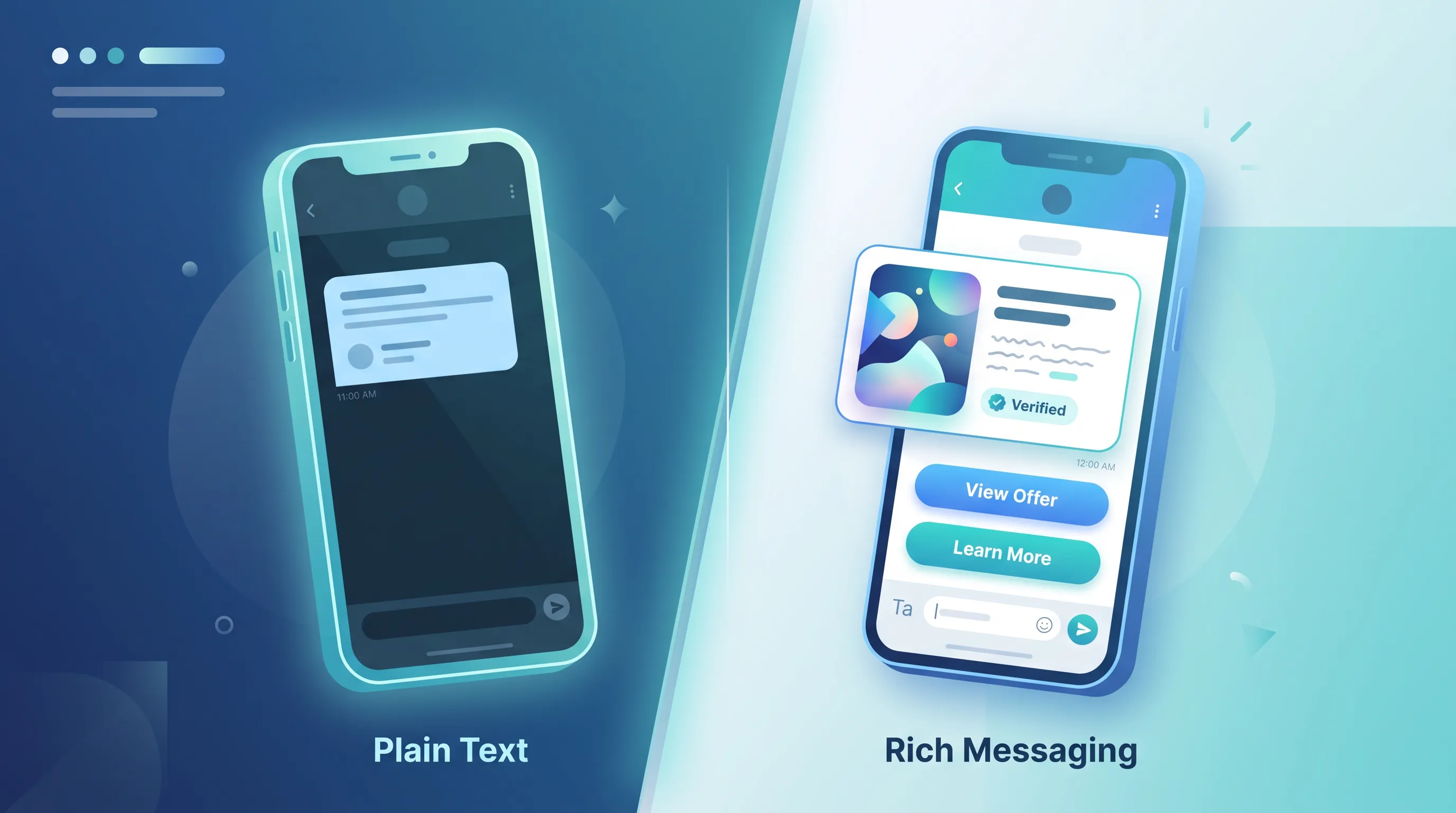
For brands that register through the business layer, RCS is genuinely richer: full-resolution images instead of compressed MMS, product carousels with buttons, suggested replies, delivery and read receipts, and — most importantly for trust — a verified sender name with a checkmark instead of a bare number. GSMA’s 2026 report highlights brands like United Airlines and IHG using it to turn one-way alerts into two-way journeys: rebooking from inside the thread, support conversations, repeat purchases. If you are a large consumer brand with an aggregator relationship, RCS deserves a line in your 2027 budget.
Where RCS still falls short
- Registration friction. Business RCS (RBM) requires a verified brand agent registered through Google’s RCS Business Messaging or a carrier aggregator, enrolled per market and billed per message on each carrier’s rate card. There is no “just start sending” path for a small sender.
- Coverage is a mosaic, not a switch. “RCS works on iOS” is true at the OS level and routinely false for a specific recipient until their carrier enables it for that device class. The recipient’s carrier decides, so every serious RCS program still plans around SMS fallback.
- Features render differently on iPhone. Apple supports business RCS alerts and updates, but not every rich primitive Android renders — carousels, webviews and persistent suggestions are not guaranteed to look the same, and persistent suggestion chips are not supported on iOS at all.
- It needs data. RCS rides mobile data or Wi-Fi. Basic phones, weak-coverage areas, and data-off situations all fall back to — of course — SMS.
- One company’s pipes. As of mid-2026, Google Messages is the only Android client that can send RCS in the US, and the major US carriers all run RCS on Google’s infrastructure. That consolidation makes the “open standard” story more complicated than it sounds.
So does a small business need RCS in 2026?
For most small senders, no — not yet. The honest decision table looks like this: if you need universal reach (OTPs, order updates, reminders, local promotions), SMS wins, because it reaches every phone on every network with zero registration. If you need rich branded journeys at scale and you already work with a messaging aggregator, pilot RCS where your audience’s carriers support it — and keep SMS fallback on. If your audience lives in WhatsApp markets, a WhatsApp campaign will usually beat both.
There is also a cost angle that rarely makes the vendor decks: every rich RCS business message is billed on a carrier rate card, on top of aggregator fees and verification. Meanwhile the SMS a small business actually needs to send — a few hundred to a few tens of thousands of messages a month — fits comfortably through an Android phone it already owns.
The case for texting from your own number
This is where an Android SMS gateway like FlixySMS sits in the 2026 landscape. Instead of renting a virtual number or short code, you pair a phone you own with the dashboard, and your campaigns, auto-replies and API sends go out as normal SMS from your real SIM:
- Reach every phone. SMS needs no data plan, no RCS-enabled carrier, no app installed. The message your customer gets on Black Friday morning does not depend on which messaging stack their carrier migrated to.
- A number people recognize. Replies land back on your phone and in the FlixySMS inbox, and the sender your customers see is the number they already have saved — not a five-digit code they have been trained to distrust.
- Flat cost. Your carrier plan covers delivery; FlixySMS pricing is a flat subscription (or a one-time lifetime plan), not a per-message meter that spikes in Q4.
- Same dashboard for WhatsApp. Where chat apps dominate, FlixySMS runs WhatsApp campaigns alongside SMS, which covers the “rich messaging” use case most small businesses actually have.
A practical playbook for the next 12 months
- Keep SMS as your reach layer. Promotions, reminders, OTPs and alerts stay on SMS — it reaches 100% of phones and nothing in the RCS rollout changes that.
- Keep messages short and reply-friendly. The trust advantage of texting from a real, answerable number grows as consumers get more suspicious of anonymous senders.
- Use WhatsApp for rich media where your market lives there. Product images, catalogs and conversational support — today, not after a carrier rollout.
- Revisit RCS in late 2027. If verified-agent registration gets cheap and self-serve the way the forecasts imply, that is the moment it becomes relevant for small senders. Watch it; do not wait for it.
The messaging stack is finally modernizing, and that is good news for everyone. But the oldest channel in the stack is still the one that delivers to every phone, every time — and in 2026 it is also still the cheapest one to own outright. Start with a FlixySMS plan, pair your phone, and your number is your platform.
Frequently Asked Questions
Do iPhones support RCS in 2026?+
Yes. Apple added RCS to the Messages app in iOS 18 (September 2024), and through 2025–2026 carriers in the US, UK and much of Europe enabled it for their iPhone subscribers. RCS messages still appear as green bubbles, and iMessage remains the default between Apple devices. Whether a specific iPhone can receive RCS depends on its iOS version and whether its carrier has enabled RCS.
Is RCS replacing SMS?+
Not yet, and not for years. RCS needs a compatible device, supported software and a data connection; SMS works on every phone, including basic handsets and phones with no data signal. Every RCS platform keeps SMS as the automatic fallback, and OTPs and critical notifications still ride SMS for exactly that reason. The practical 2026 posture is: SMS for reach, RCS where it is verified and supported.
Can a small business send RCS messages directly?+
Not the way it can send SMS. Business RCS (RBM) requires registering a verified brand agent through Google’s RCS Business Messaging or a messaging aggregator, with per-carrier enrollment and per-message rate cards. There is no RCS equivalent of plugging in your own phone and texting your customers from your own number — which is exactly what an Android SMS gateway gives you today.
Does texting from my own Android phone use RCS or SMS?+
FlixySMS sends through your Android phone’s SMS and MMS channels, so delivery works to every phone regardless of RCS support, data coverage, or platform. Recipients see your real number, can reply normally, and nothing about Apple’s RCS rollout changes how those messages are delivered.
What is the difference between RCS and WhatsApp for business messaging?+
WhatsApp is an app people must install and runs on its own network with its own business API; RCS lives inside the phone’s default messaging app with no extra account. WhatsApp dominates in much of Europe, Latin America, Asia and Africa, while RCS rides the native inbox. Many businesses run both — FlixySMS supports WhatsApp campaigns alongside SMS from the same dashboard.
Related Tools
FlixySMS Android Gateway
Send SMS from your own number through a phone you already own — universal reach, flat price.
WhatsApp Campaigns on FlixySMS
Run WhatsApp alongside SMS from the same dashboard for markets where chat apps win.
FlixySMS Pricing
Flat monthly and one-time lifetime plans with no per-message fees or carrier registration.