Holiday Text Scams in 2026: How to Text Customers Without Looking Like One
SMS Marketing
Holiday Text Scams in 2026: How to Text Customers Without Looking Like One: direct answer
Holiday Text Scams in 2026: How to Text Customers Without Looking Like One is a FlixySMS guide about sms marketing for teams that use Android phones, WhatsApp devices, or REST APIs to manage customer messaging.
Key facts
- Nearly half of US adults got a fake shipping text this year. Here is how scam texts work in the 2026 holiday season, and the seven habits that make your real business texts look nothing like them, with before-and-after templates.
- The reading time is 9 minutes, so the guide is designed for quick implementation research.
- Related tags include sms scams, smishing, SMS Marketing.
- The article is connected to FlixySMS structured Article JSON-LD, canonical metadata, and internal related-post discovery.
- This guide was published on November 23, 2026 and has an estimated 9-minute reading time.
Process
- 1First, identify the exact messaging workflow the article addresses.
- 2Next, compare the workflow against FlixySMS device, API, integration, and plan requirements.
- 3Then, run a small test send or received-message test before scaling the workflow.
- 4Finally, track delivery, replies, and failures from the dashboard or API.
Nearly half of US adults got a fake shipping text this year. Here is how scam texts work in the 2026 holiday season, and the seven habits that make your real business texts look nothing like them, with before-and-after templates.
TL;DR
Holiday text scams peak in late November and December: AARP’s 2026 Holiday Shopping and Scams report found 47% of US adults received a fake shipping alert and 44% a fake toll text, and 9% of people who got a scam text paid. Scammers rely on urgency, small fees, unfamiliar links and anonymous senders. Legitimate businesses avoid looking like them by texting only people who opted in, opening with the brand name, referencing something the customer recognises (an order number), linking only to their own full domain, never asking for payment details or codes by text, sending from one consistent number customers can reply to, and telling customers in advance what they will and will not text.
Holiday text scams are at their yearly peak, and they are making real business texts harder to trust. AARP’s 2026 Holiday Shopping and Scams report, published November 11, found that 47% of US adults received a fake shipping alert in the past year and 44% received a fake toll-payment text. Of the people who got a scam text, 9% paid. The US Treasury issued its own holiday scam advisory on November 18. If your business texts customers in December, you are competing with those messages for the same few seconds of attention. This guide explains how the scams work and the habits that make your messages look nothing like them, with before-and-after templates you can copy.
What do holiday text scams look like in 2026?
Almost every scam text this season follows one of five scripts:
- Fake delivery problem. “Your package could not be delivered. Update your address within 24 hours.” This is the most common one. The US Postal Inspection Service points out that USPS does not text you a link unless you requested tracking for a specific package.
- Unpaid toll or fee. A small, believable amount owed, with a penalty if you do not pay today. AARP found reports of toll texts fell from last year but still reached 44% of adults.
- Bank fraud alert. “Did you approve a $649 purchase? Reply NO,” followed by a call from a fake fraud department asking for a one-time code.
- Gift and prize offers. A free gift, a QR code, or a “claim your reward” link. Postal inspectors call the QR version “quishing.”
- Fake charity appeals. AARP found 31% of adults received a donation request that looked fake or suspicious, and 62% do not consistently research a charity before giving.
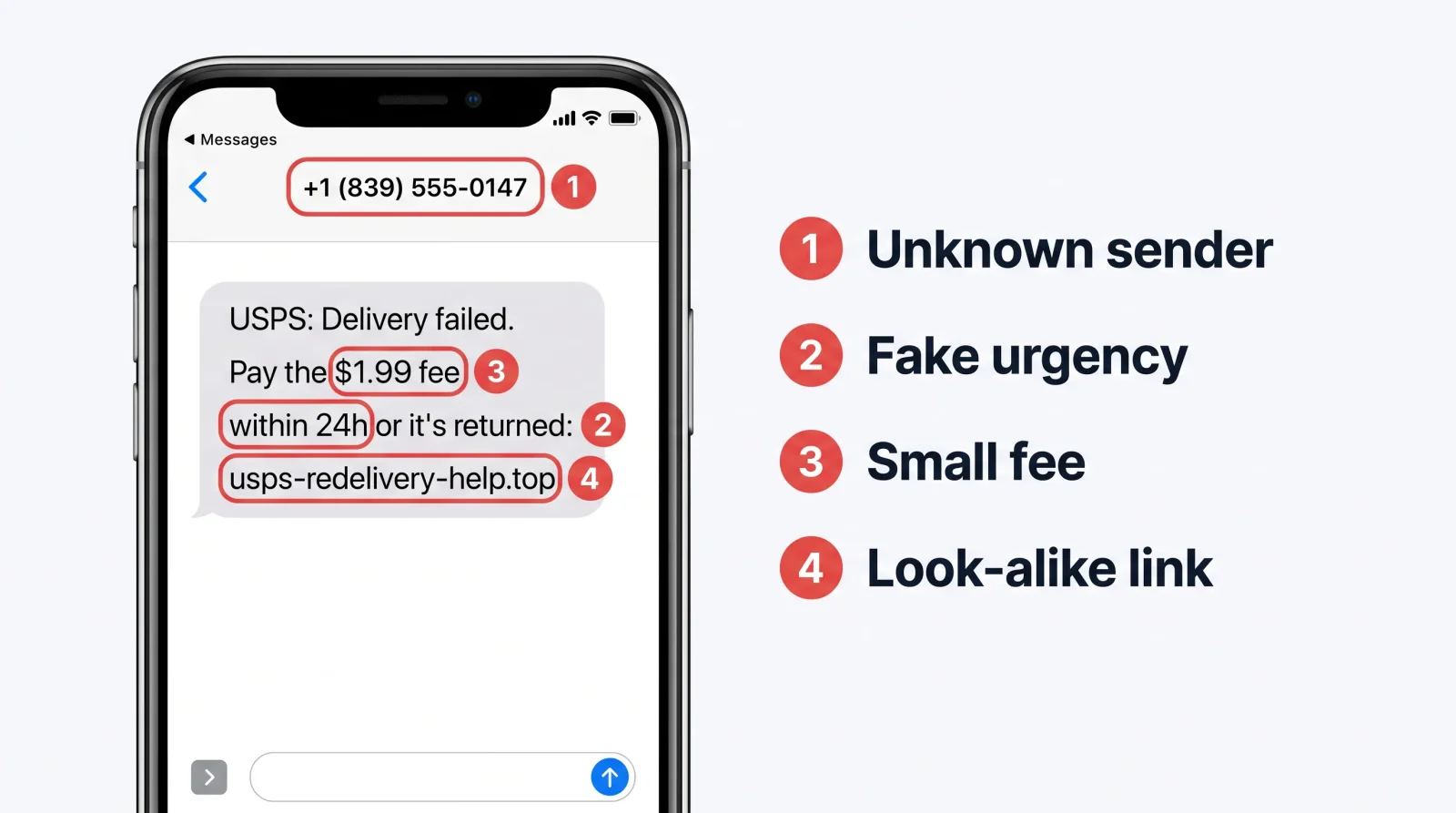
The common thread is not the topic but the pattern: an unexpected sender, urgency, a request for money or details, and a link you cannot verify. Treasury’s advisory adds a new layer this year, warning that criminals use AI to impersonate businesses and even family members more convincingly. Scammers also send these in bulk and guess, as the Southland Credit Union put it in a November 16 consumer warning: they do not need to know you ordered anything, because during the holidays most people did.
Why this is your problem, not just your customers’
Every fake delivery text teaches your customers to distrust real ones. When nearly half of adults have seen a fraudulent shipping alert, a genuine “your order has shipped” message from an unknown number with a link looks exactly like the thing they were warned about. The costs show up as lower click-through on order updates, more “is this real?” replies and support tickets, more “where is my order?” contacts, and more people reporting your number as spam, which hurts deliverability for everyone on it.
The fix is not to stop texting. It is to make every message obviously, boringly legitimate.
7 habits that make business texts look nothing like scams
1. Only text people who expect it
Scammers text strangers. You should only text people who opted in, and you should tell them at checkout or sign-up what they will receive: “We’ll text your order and shipping updates from (555) 010-0100.” A text the customer was told to expect is the strongest trust signal there is. In FlixySMS, every new campaign is checked against your stop list and blacklist before it sends, so people who opted out do not hear from you again by accident.
2. Lead with your brand name
Start every message with the name customers know you by, the same way every time: “Northside Bakery:” rather than a generic “Hi there!” Scam texts are vague about who they are because they are pretending to be many companies at once.
3. Reference something only you would know
A scammer guessing in bulk does not know your customer’s name or order number. You do. FlixySMS campaigns accept variables like {first_name} and {last_name}, and the Shopify and WooCommerce order templates fill in {{customer_name}} and {{order_number}} automatically. “Hi Maya, order #1042 has shipped” is far harder to fake than “Your package is on its way.”
4. Link only to your own, readable domain
Generic link shorteners and odd-looking domains are the most visible sign of a scam text. Use your real domain with a readable path, such as yourstore.com/orders/1042, and never link to a payment or login page the customer was not expecting. For shipping updates, add “or check status in your account” so cautious customers have a way in that does not involve clicking.
5. Never ask for payment details, passwords or codes by text
Not once, not even for a real failed payment. Tell customers to sign in to your website to update a card. When you send verification codes, add “We will never call or text to ask for this code.” That single line protects your customers from the most common account-takeover script.
6. Send from one consistent number customers can reply to
Scam texts come from a different number, or an email address, every time. If your texts always come from the same number, customers can save it as a contact, recognise it, and reply to it. This is a practical advantage of sending through FlixySMS: messages go out from the Android phone and number you already own, so a reply reaches you and the number stays the same from the order confirmation to the delivery notice.
7. Drop fake urgency and fees from transactional texts
“Act within 24 hours or your package will be returned” is scam language. Real shipping updates do not need a deadline, and a real store almost never asks for a fee by text. Keep urgency for genuine promotions sent to opted-in subscribers, and even there, name a real date rather than a countdown threat.
Before and after: rewriting texts that look like scams
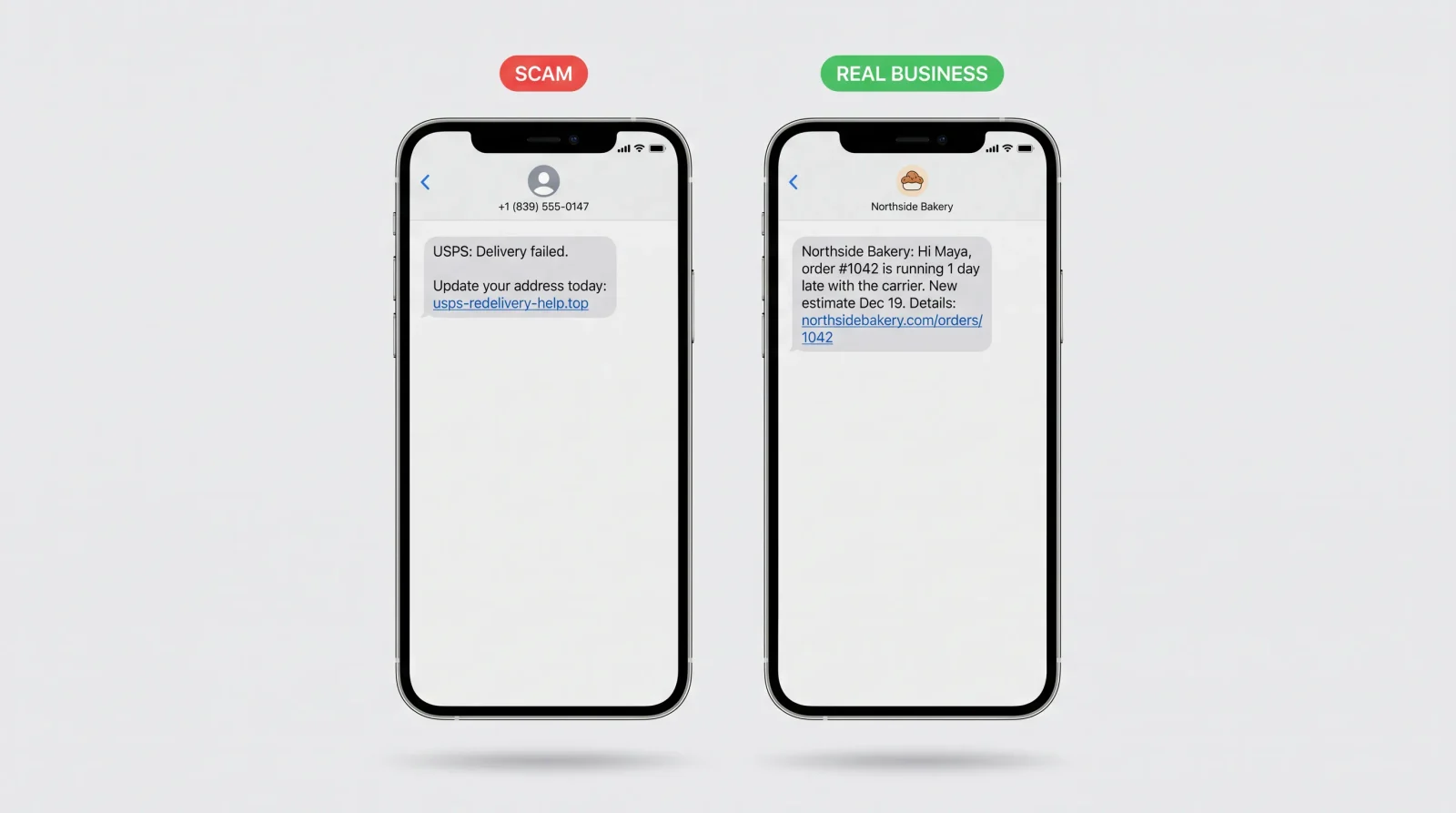
Each “before” below is a real kind of message legitimate stores send. Each “after” passes the scam sniff test:
- Before: “Your package is delayed. Click here to reschedule: bit.ly/3xYz”
After: “Northside Bakery: Hi Maya, order #1042 is running 1 day late with the carrier. New estimate Dec 19. Details: northsidebakery.com/orders/1042” - Before: “Payment failed! Update your card now to avoid cancellation.”
After: “Northside Bakery: we couldn’t charge the card on order #1042. Please sign in at northsidebakery.com to update it. We’ll never ask for card details by text.” - Before: “Congrats! You’ve been selected for a FREE holiday gift. Claim now!”
After: “Northside Bakery: thanks for being a regular, Maya. Your $10 holiday credit is already on your account. Use it by Dec 31. Reply STOP to opt out” - Before: “Your verification code is 482913.”
After: “Northside Bakery code: 482913. Valid for 10 minutes. We will never call or text to ask for this code.” - Before: “Last chance!!! Your order will be returned in 24h unless you confirm your address.”
After: “Northside Bakery: the carrier needs a gate code for order #1042. Reply here with it, or call us at (555) 010-0100.”
Set it up once, in FlixySMS
- Pair your device. Install the FlixySMS Android app and scan the pairing QR code from the dashboard. The number on that phone becomes the one customers see every time.
- Announce the number at checkout. Add a line to your order confirmation page and email: “Order updates will come by text from (555) 010-0100.”
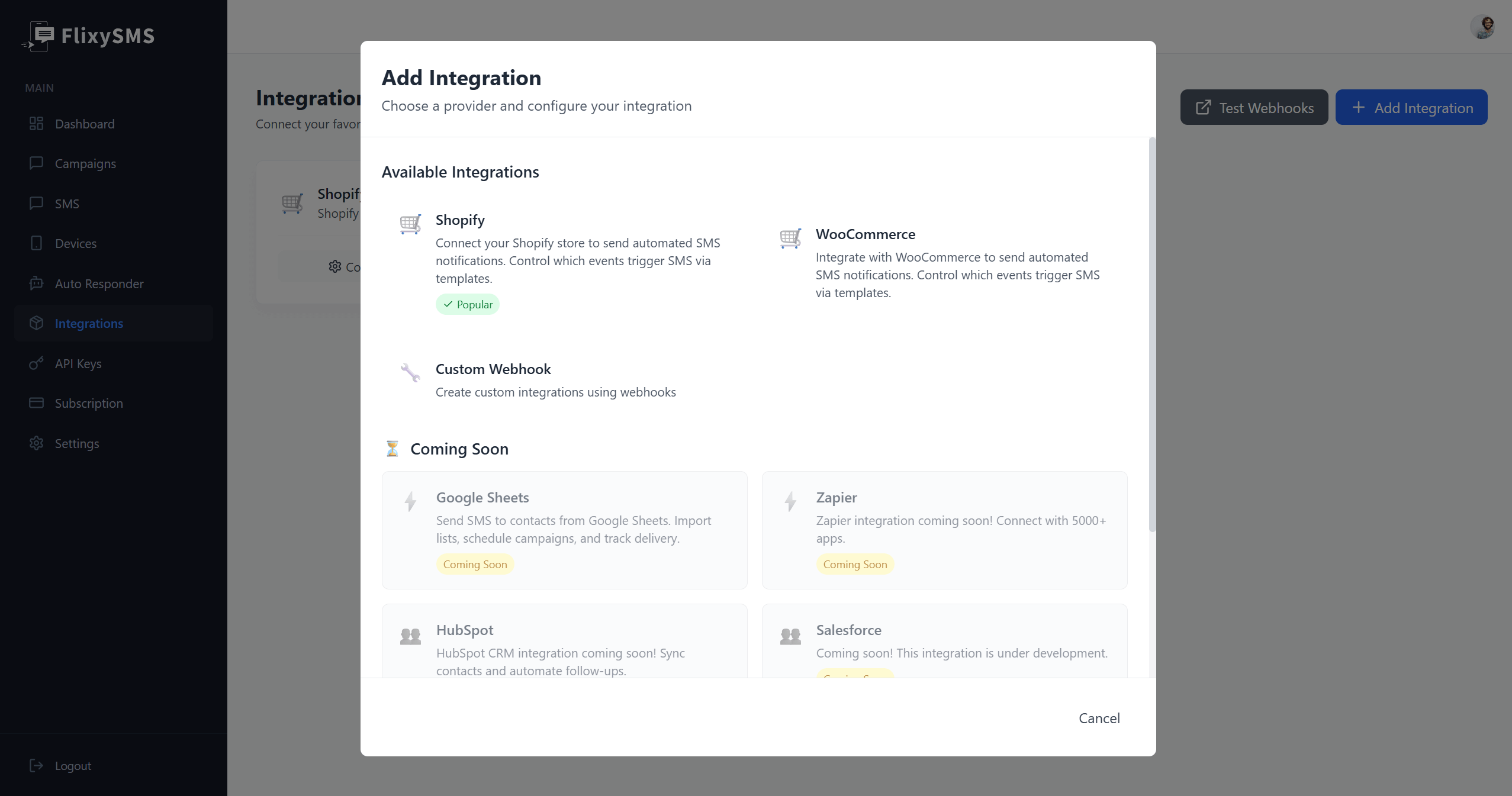
- Turn on order templates. In Integrations, connect Shopify or WooCommerce and edit the order-created and shipped templates to open with your brand name and the order number.
- Personalise campaigns. In the campaign editor, use
{first_name}in promotional texts and keep the stop list current so opted-out contacts are skipped. - Publish a “how we text” note. One short page on your site: the number you text from, what you send, and what you will never ask for by text. Link it from your FAQ and your order emails.
If you trigger messages from code, the same rules apply to the REST API. Build the brand name and order number into every message body you send. For the shipping side of December specifically, see our holiday shipping deadlines guide, which includes a full order-update text sequence.
What to do when scammers impersonate your business
- Warn customers in your own channels with a screenshot of the fake and a reminder of the number you really use.
- Tell them how to report it: forward the text to 7726 (SPAM), report at ReportFraud.ftc.gov, and for USPS impersonation email spam@uspis.gov.
- Give them a safe path: “Check any order by signing in at yourstore.com, never through a link you didn’t expect.”
- Keep your own habits consistent. Impersonation works best against businesses that text inconsistently. The more predictable your messages are, the easier fakes are to spot.
Scam texts will not disappear after the holidays, but the businesses that keep texting predictably, from the same number, with real details, are the ones customers keep trusting in January.
Frequently Asked Questions
What are the most common holiday text scams in 2026?+
Fake delivery notices are the biggest: AARP’s November 2026 report found 47% of US adults received a fraudulent shipping alert in the past year. Unpaid-toll texts (44%), fake bank fraud alerts, gift-card requests and fake charity appeals follow. They all push urgency, ask for a small fee or personal details, and link to a look-alike website.
How do I make my business text messages look legitimate?+
Only text customers who opted in, start every message with your brand name, mention something specific they recognise such as their order number, link only to your own full domain, never ask for card numbers, passwords or verification codes, send from one consistent number they can reply to, and tell them at checkout which number you will text from.
Should businesses avoid links in text messages?+
No, but use them carefully. Generic link shorteners are the hallmark of scam texts, so link to your own domain, keep the path readable (yourstore.com/orders/1042), and never send a link that leads to a payment or login form the customer did not expect. For order updates, also tell customers they can check status in your app or account instead of clicking.
Why are customers ignoring my legitimate shipping texts?+
Because scam shipping texts trained them to. With nearly half of adults seeing fake delivery alerts, an unexpected text with a link from an unknown sender gets deleted. Set the expectation at checkout, send from the same number every time, open with your brand name and the order number, and avoid fees or urgent deadlines in shipping messages.
What should I tell customers who receive a scam text pretending to be my business?+
Tell them to not click, forward the message to 7726 (SPAM) so their carrier can block the sender, report it at ReportFraud.ftc.gov, and check the order directly on your website or app. Then publish a short note on your site listing exactly what your business does and does not send by text.
Related Tools
FlixySMS Campaigns
Personalised campaigns from your own number, with stop-list and blacklist checks before anything sends.
FlixySMS Integrations
Shopify and WooCommerce order texts that include the customer’s name and order number automatically.
FlixySMS Pricing
Flat plans with no per-message carrier fees, including one-time lifetime team plans.